Overview
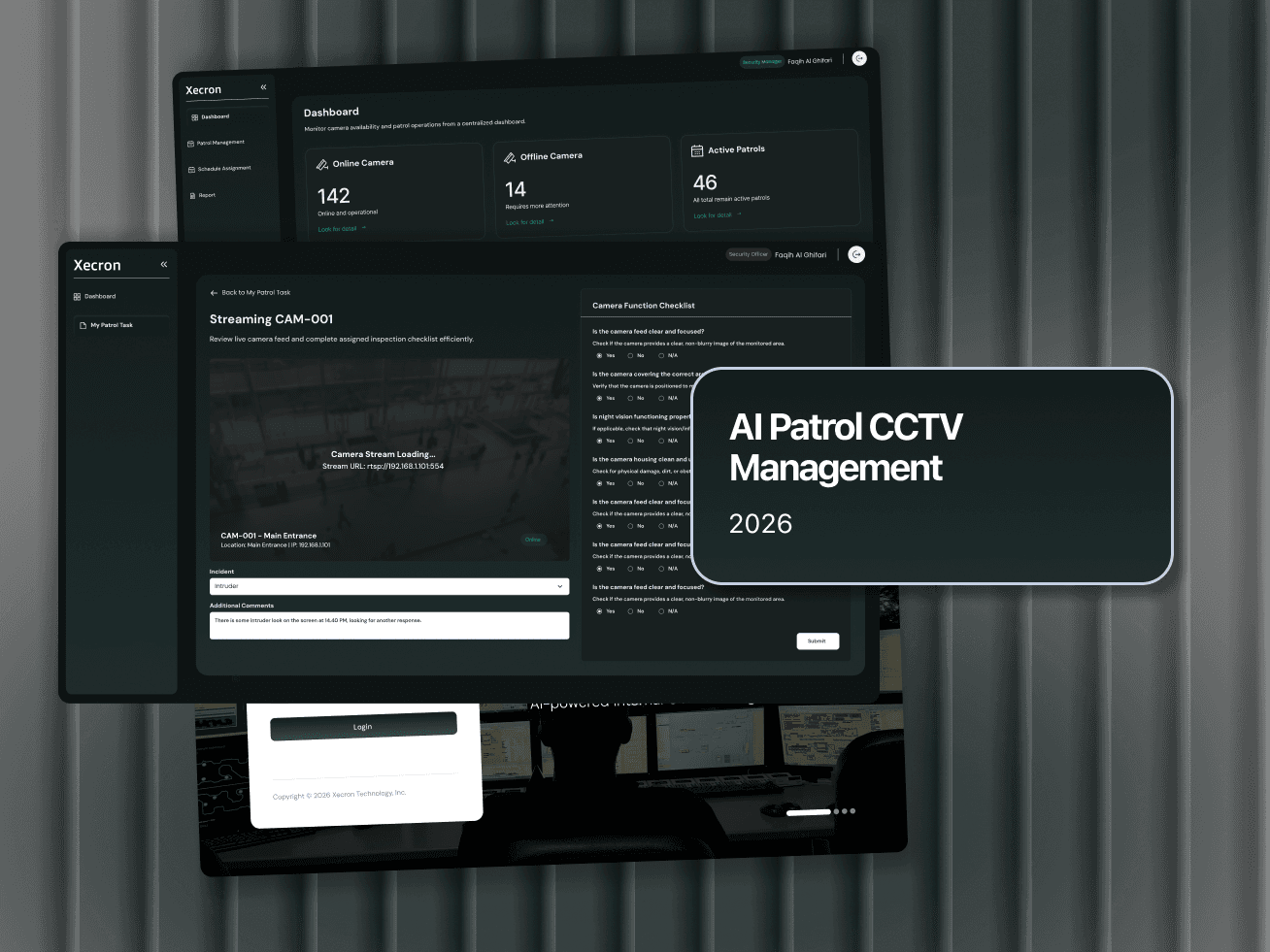
A web-based AI Patrol CCTV Management System developed for a global semiconductor manufacturing company — designed to support security patrol operations across the manufacturing facility, enabling real-time camera monitoring, patrol scheduling, incident management, and security reporting. Covering 14 modules across 3 user roles (System Admin, Security Officer, Security Manager), with Phase 1 successfully delivered to the client within a 1-month timeline.
Objective
To design an end-to-end AI-powered patrol management platform that centralizes and digitizes client security patrol operations — replacing manual or fragmented processes with a structured, role-based system that improves surveillance coverage, incident response accuracy, and operational oversight.
Problem Statement
Fragmented security operations: Security patrol activities, camera monitoring, incident reporting, and schedule management lacked a unified digital platform — limiting operational visibility and coordination across security roles.
Multi-role workflow complexity: The system needed to serve 3 distinct roles — System Admin, Security Officer, and Security Manager — each with different access levels, responsibilities, and workflow needs within the same platform.
Incident response efficiency: Without a structured incident management and reporting system, tracking, escalating, and documenting security incidents was time-consuming and prone to inconsistency.
User adoption risk: Security personnel operating in a manufacturing environment required an intuitive interface and clear operational guidance to adopt a new digital system without disrupting existing patrol workflows.
My Role
UI/UX Designer in a project team at Merkle Innovation — responsible for end-to-end design execution including requirement gathering, stakeholder alignment, design system creation, wireframing, high-fidelity UI, prototyping, iterative design, developer handoff, and user guide production for all roles.
Process
Requirement Gathering & Stakeholder Alignment: Conducted requirement gathering sessions with the Product Owner and client stakeholders to define the system's problem statement, design expectations, and role-specific feature needs across all 3 user roles.
Design Direction & System Building: Established the visual and interaction direction aligned with client requirements and client operational context. Built a comprehensive design system as the foundation for consistent UI execution across all 14 modules.
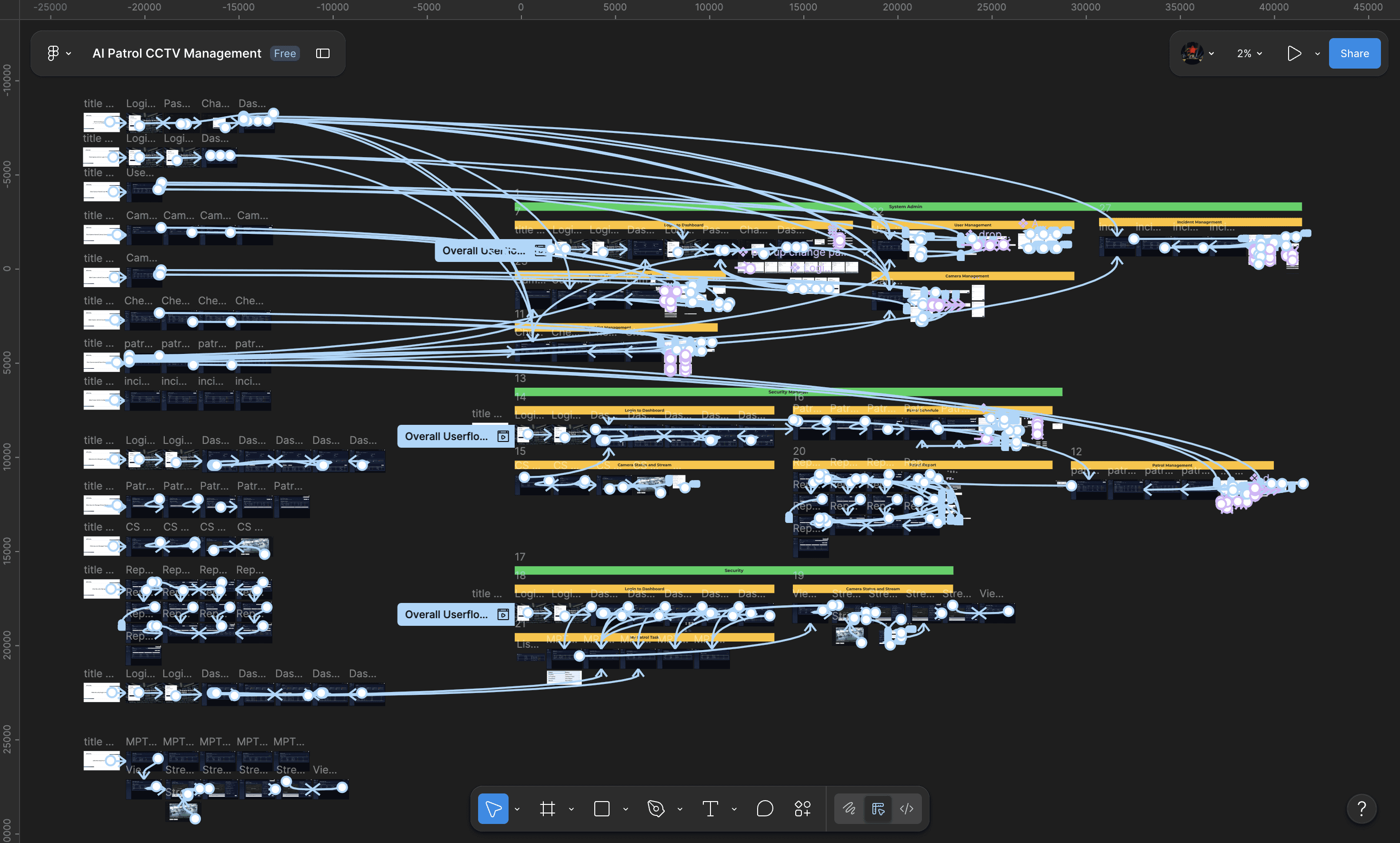
End-to-End Design Execution: Produced wireframes, high-fidelity UI, and interactive prototypes covering the full system scope: dashboard, master data management (user, checklist, incident, camera template, camera, configuration), incident management, camera status monitoring, schedule management and assignment, reporting, patrol task management, and incident reporting.
Iterative Review & Handoff: Conducted iterative design reviews with stakeholders, refining based on feedback until designs met client expectations. Delivered complete design handoff to the development team upon approval.
User Guide Production: Produced a comprehensive step-by-step user guide covering all features across all 3 user roles, delivered directly to the client to support system onboarding and adoption post-launch.
Solution
Designed 14 modules covering the complete security patrol lifecycle — from camera and user configuration to real-time patrol task execution, incident reporting, schedule management, and management-level reporting dashboards.
Served 3 distinct user roles with tailored interfaces and role-appropriate access flows, balancing operational simplicity for field-level Security Officers with comprehensive oversight tools for Security Managers and System Admins.
Delivered a complete role-based user guide as an additional deliverable, directly supporting client-side user onboarding and reducing adoption risk for security personnel unfamiliar with digital patrol systems.
Successfully completed Phase 1 delivery within a 1-month timeline, receiving positive feedback from client stakeholders — with Phase 2 confirmed as the project continuation.
Documentation
Note
This is a confidential internal system for a global semiconductor manufacturing client. UI screenshots are not publicly shareable.