Overview
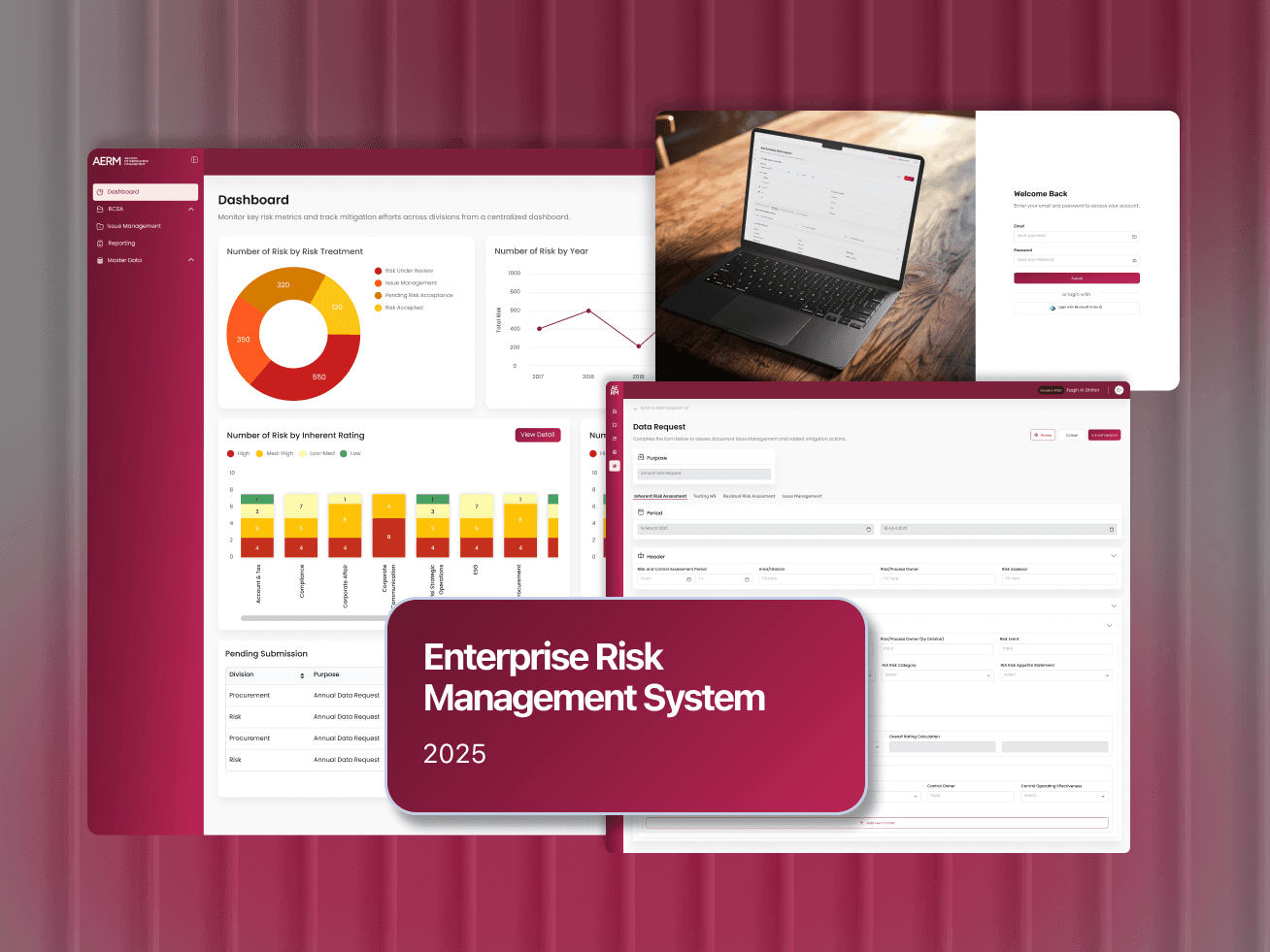
A web-based Enterprise Risk Management (ERM) System developed for a state-owned national investment authority, transforming their existing spreadsheet-based risk management workflow into a centralized digital platform serving 4 distinct user roles across 12 system modules, delivered over a 5-month Agile development cycle.
Objective
To design and deliver an end-to-end UI/UX solution that digitizes client internal risk management process — replacing manual, fragmented spreadsheet workflows with a scalable enterprise system that improves operational efficiency, data accuracy, and usability across cross-functional internal teams.
Problem Statement
Legacy workflow dependency: Users relied entirely on spreadsheets to manage risk data, resulting in fragmented information, limited scalability, and high risk of human error across teams.
Complex and unintuitive user flows: Transitioning from spreadsheet-based habits to a structured digital system introduced significant UX challenges — existing user mental models did not align with the new system's logic.
Multi-role complexity: The system needed to serve 4 distinct user roles — System Admin, Division Staff, Division Manager, and Risk Team — each with different access levels, permissions, and workflow needs.
Adoption risk: Without proper onboarding support and intuitive design, user adoption posed a significant risk to the project's overall success.
My Role
Solo UI/UX Designer embedded in an Agile Scrum team, responsible for the full design lifecycle across Sprint 0–7 — from requirement gathering to UAT delivery.
Process
Requirement Gathering & Analysis: Collaborated with the Product Owner to map user requirements across all 4 roles. Analyzed existing spreadsheet data and workflows to extract user stories, translating them into feature specifications across 12 system modules.
Wireframing & High-Fidelity Design: Produced wireframes to validate structure and flow, then developed high-fidelity UI designs with a comprehensive design system ensuring visual consistency across all modules.
Prototyping & Iterative Testing: Built interactive prototypes in Figma for QA testing across 7 sprint cycles (194 total story points). Design decisions were refined iteratively based on QA findings and stakeholder feedback.
UX Writing & Flow Simplification: Redesigned user flows to reduce complexity inherited from spreadsheet-era processes. Applied clear, role-appropriate UX writing to guide users through key tasks without prior training.
User Guide Development: Created role-specific user guides for all 4 user roles, covering step-by-step instructions for all system features to support independent adoption post-launch.
Solution
Designed 12 system modules solo across a 5-month Agile cycle, covering the full risk management lifecycle from data capture to review, approval, issue management, and executive reporting.
Served 4 distinct user roles with tailored interfaces and role-based access flows, balancing consistency across the platform with role-specific workflow needs.
Delivered a complete Figma design system and dev-ready prototype, enabling efficient and consistent implementation by the development team.
Produced 4 role-specific user guides, directly supporting user onboarding and reducing adoption risk post-UAT.
Achieved successful UAT delivery with positive stakeholder reception and active system adoption by end users.
Documentation
Note
This is a confidential internal system for a government-linked investment institution. Full system details are confidential.